









Some days your energy doesn't crash so much as quietly drains away, the kind of tiredness that coffee papers over but never really fixes. For centuries, Traditional Chinese Medicine (TCM) has had a root many people reached for in exactly those seasons: 刺五加 (cì wǔ jiā), known in English as eleuthero root. Classically described as acrid, slightly bitter, and warming, it was used to tonify Qi (the body's vital energy), fortify the Spleen and Kidney systems, and calm the Shen (the mind and spirit). In plain terms, it was the herb for people running low on reserves.
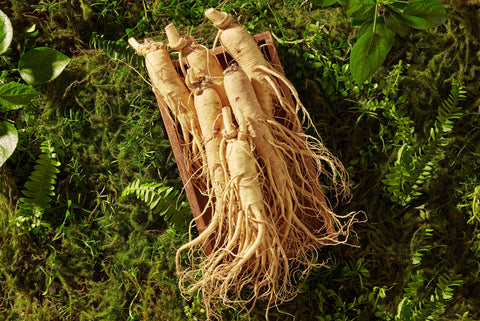
In Western terms, eleuthero is Eleutherococcus senticosus, a thorny shrub from the forests of the Russian Far East, northern China, Korea, and Japan. You may know it by its common, and slightly misleading, name, Siberian ginseng, though it is not a true ginseng at all. Its roots are rich in a group of compounds called eleutherosides, along with polysaccharides and caffeoylquinic acids. It is also the plant most associated with the birth of the word adaptogen, a term coined by Soviet researchers in the twentieth century for substances that help the body resist and adapt to stress.
TCM Realms: What Eleuthero Did for the Ancients
Tonifying Qi and lifting fatigue
In TCM, lasting energy depends on healthy Qi, and much of that Qi is generated by the Spleen system as it transforms food into usable fuel. When the Spleen is weak, the classic picture is heaviness, a foggy head, low appetite, and fatigue that rest alone doesn't lift. Eleuthero was valued as a gentle Qi tonic, less forceful than ginseng but steady, and well suited to everyday use over long stretches of time.
Supporting the Kidney and deep reserves
TCM sees the Kidney system as the body's foundational reserve, the deep battery that governs stamina, resilience, and recovery. Eleuthero was used to supplement the Kidney and Spleen together, which is why classical sources connected it to a strong lower back and knees, physical endurance, and bouncing back after overexertion or a long illness.
Calming the Shen
Because eleuthero enters the Heart and Spleen channels, it was also considered a herb that calms the Shen (spirit). When chronic depletion left someone wired but tired, with restless sleep and too many dreams, eleuthero's calming action was thought to settle the mind by rebuilding the foundation underneath it, rather than by forcing sedation.
Why Modern Science Is Paying Attention to Eleuthero Root
The original adaptogen for energy and endurance
Eleuthero root is arguably the most studied adaptogen of all. Interest took off in the 1950s and 60s, when Soviet scientists Nikolai Lazarev and Israel Brekhman went looking for a natural way to support the stamina and focus of athletes, pilots, and workers, and chose eleuthero as an affordable stand-in for ginseng. A 2009 review of clinical trials concluded there was good evidence that eleuthero can increase endurance and mental performance in people with mild fatigue and weakness, and the European Medicines Agency now recognizes the root for symptoms of asthenia, meaning fatigue and weakness. In everyday language: it is best understood as gentle, cumulative support for steady energy, not a jolt like caffeine.
Immune support and whole-body balance
Eleuthero has also drawn attention for how it interacts with the immune system. In one double-blind, placebo-controlled study, healthy adults who took a daily eleuthero extract for four weeks showed a notable rise in immune cells, including T helper lymphocytes and natural killer cells, which are part of how the body stays defended and balanced. Laboratory research points to eleutherosides and other compounds that appear to help modulate inflammation, offering a possible explanation for the traditional view of eleuthero as a herb that keeps the body resilient rather than over-reactive. As with most botanicals, the research is still developing, and the strongest findings point to gentle, cumulative support rather than dramatic overnight effects. That picture lines up closely with how TCM used eleuthero all along: a mild, well tolerated daily tonic for people who feel run down.
Why This Matters Now
Modern life asks a lot of our reserves: long hours, patchy sleep, constant stress, and immune systems that rarely get a real break. That is exactly the territory eleuthero has occupied for centuries, first as a TCM Qi tonic and later as the herb that defined the entire adaptogen category. It won't override your body, and it isn't a quick fix. What it offers is gentler and, for a lot of people, more sustainable: a little more steadiness in your energy, a little more resilience under pressure, and support for the immune system doing its quiet daily work.
You will find eleuthero root working alongside ginseng, gyokuro green tea, white mulberry leaf, and turkey tail mushroom in our Energy + Immunity blend, a formula rooted in Traditional Chinese Medicine and designed to support clear, steady energy and everyday immune balance, without the crash. One ancient root, brought forward for the way we actually live now.